

New developments following the presentation of the Hippocrates Award
The impact generated by the Hippocrates Award has led managers at other institutions to consider which elements can be applied in their own settings and where practices can be optimized. The completion of a support guide now allows our network partners to better understand the steps involved in modernizing our practice and to benefit from suggested tools for its implementation. This document aims to be more than just a sharing of a development experience: the evidence that inspired this approach is highlighted, as are the structure and tools that emerged from this modernization of our professional practice. Sharing our educational handouts, to foster greater engagement among patients and their loved ones, is also a priority. This initiative promotes collaboration among network stakeholders on a shared challenge: the aging population.
Impacts in terms of value creation in healthcare
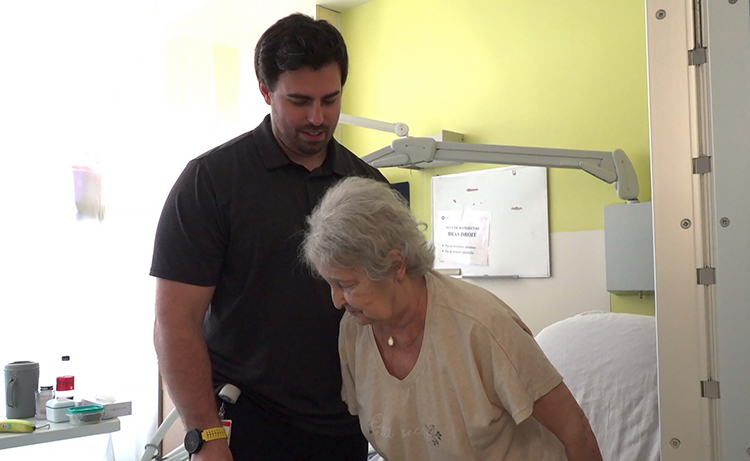
The results demonstrate that a setting for highly specialized care and services can be the site of effective interventions to prevent functional decline. A 25% reduction in falls and a 38% reduction in near-falls were recently measured in the units participating in the project. As for Grade D falls, they decreased by 30%. These falls require mandatory reporting and additional assessments to verify the occurrence of consequences. A reduction in the severity of falls allows care staff to focus on other clinical tasks, while promoting a safer care environment for residents. For the target population, a decrease of up to 11% in residents with prolonged stays (DMS ≥ 10 days) was also observed.
Our New Practice in Response to Future Challenges
This project incorporates new strategies for the medicine of the future, which could be more predictive, preventive, personalized, and participatory. Identifying individuals with a high level of frailty is becoming a key factor in our management of bed occupancy durations. We are currently analyzing the potential benefits of extending this new practice to pulmonology patients in outpatient settings. Eventually, it will also be worthwhile to evaluate the potential of the tools developed in surgical settings or within the context of geriatric emergencies to improve discharge planning.
AWARD FOR OPTIMIZATION AND MODERNIZATION OF PROFESSIONAL PRACTICES TO PROVIDE MORE TIME FOR THE PATIENT – 2023
Team led by Dr. Sophie Bellavance and Dr. Isabelle Roussin Collin, Quebec University Institute of Cardiology and Pulmonology, Laval University
Project: Preventing the risks of functional decline and falls in the hospital setting through an innovative interdisciplinary approach